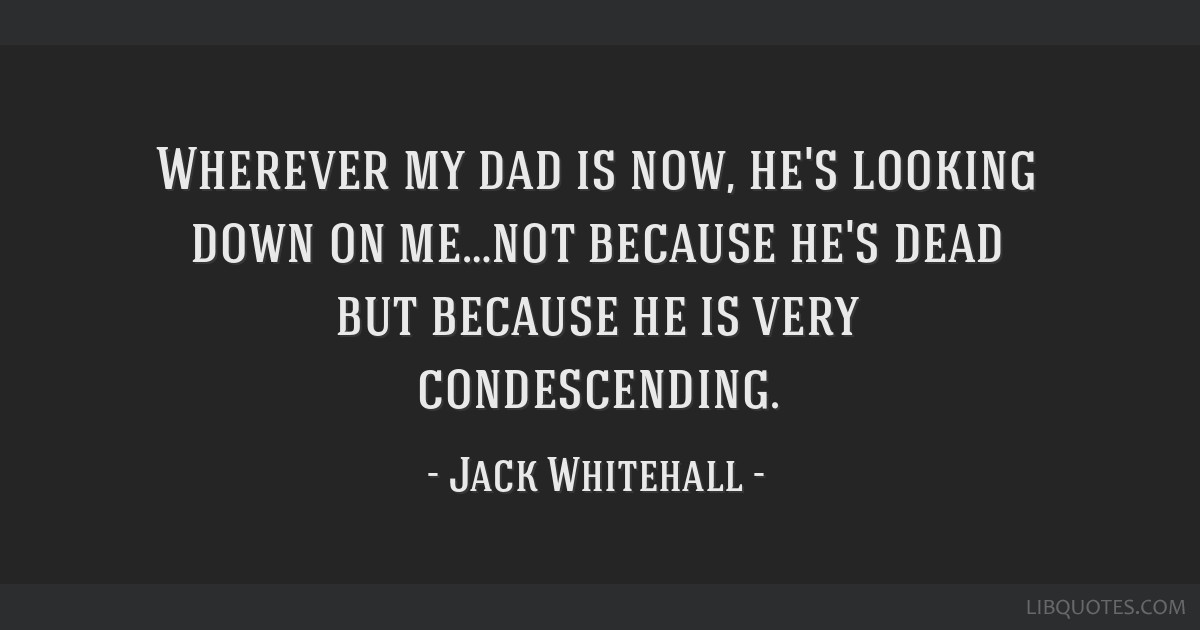
There’s a moment in one of Jack Whitehall’s stand-up specials where he delivers a line so casually profound it lands like a punchline and a life lesson in one breath: “I’m sure wherever my dad is, he’s looking down on us. He’s not dead—just very, very disappointed.” On the surface, it’s classic British sarcasm—familiar, self-deprecating, and instantly relatable. But peel back the humor, and you’re left with a sharp commentary on honesty, workplace dynamics, and the unspoken truths of human behavior. This isn’t just a throwaway joke. It’s a mirror.
In an era where authenticity is both currency and rarity, Jack Whitehall—comedian, actor, writer, and television personality—uses comedy to dissect real emotional terrain. His quote of the day isn’t about death or family estrangement. It’s about perception, accountability, and the subtle performance we all engage in daily. Whether in boardrooms, family dinners, or social media bios, we’re always being “looked down upon” by someone—real or imagined. And that gaze shapes how we act, what we admit, and how we lead.
Let’s break down why this single quote holds weight far beyond the comedy circuit.
The Power of Self-Aware Humor in Leadership
Whitehall’s joke works because it’s layered. The setup—“looking down on us”—evokes the cliché of deceased loved ones watching from above. The twist—“he’s not dead, just disappointed”—subverts it with brutal honesty. That pivot from reverence to relatability is where real insight lives.
In leadership and work culture, this kind of self-awareness is rare but transformative. Most leaders avoid admitting fault or showing vulnerability. They craft polished personas, fearing that honesty might undermine authority. But Whitehall’s humor does the opposite—it builds connection. By acknowledging his father’s silent judgment, he invites the audience into a shared experience of not measuring up.
Practical example: A manager opens a team meeting by saying, “I know last quarter’s numbers weren’t great. Honestly, if my mentor saw that report, she’d probably ask if I’d lost my mind.” That admission—framed with humor—lowers psychological barriers. It signals: I see the gap, and I’m not pretending it doesn’t exist. Teams respond to that. Trust increases. Defensiveness drops.
Contrast this with the alternative: denial, overconfidence, or deflecting blame. These are the habits that erode work culture over time. Whitehall’s quote, though comedic, illustrates a leadership truth—credibility often comes not from perfection, but from owning imperfection.
Honesty as a Social Performance
We often treat honesty as a binary: you’re either truthful or you’re lying. But in practice, honesty is a spectrum shaped by context, audience, and ego. Whitehall’s joke exposes this. His father isn’t actually “looking down”—that’s a metaphor. The real pressure comes from internalized expectations, the imagined gaze of someone whose opinion matters.
This reflects how honesty operates in workplaces. People don’t always lie outright. They omit, soften, or repackage truth to avoid conflict, preserve image, or protect relationships. A junior employee might say, “I’m still working on that project,” when the real story is, “I haven’t started, and I’m overwhelmed.” The words aren’t false—but the full truth is absent.
Whitehall’s line works because it names the unspoken. He admits his dad is alive, present, and judging—and that the weight of that judgment alters behavior. In professional settings, the same dynamic plays out with bosses, clients, or even peers. We act differently when we believe we’re being watched.
Common mistake: Organizations encourage “open feedback” but punish candor. Employees learn to perform honesty—delivering safe, sanitized versions of truth. The result? Innovation stalls, problems fester, and trust decays.
Workflow tip: Normalize “disappointment-safe” conversations. Create spaces where people can say, “I messed up,” or “I don’t know,” without career risk. Use humor when appropriate—like Whitehall does—to disarm tension and invite authenticity.
Work Culture and the Myth of Constant Approval
One of the quiet tragedies of modern work culture is the expectation of perpetual validation. Employees seek praise. Leaders crave admiration. Companies brand themselves as “family.” But Jack Whitehall’s quote cuts through that illusion. His father’s disappointment isn’t a failure—it’s a given. It’s part of the relationship.
That’s a radical idea in a world obsessed with engagement scores and 5-star reviews. What if, instead of chasing approval, we accepted that meaningful work—and meaningful relationships—involve friction? That someone important might look at what you’ve done and say, “You can do better”?
Realistic use case: A creative team presents a campaign to a senior executive. Instead of nodding along, she says, “This feels safe. Where’s the risk?” That’s not rejection. It’s investment. Like Whitehall’s father, she’s engaged enough to care—and care enough to push.
The healthiest work cultures aren’t those where everyone agrees. They’re the ones where people feel safe to disappoint—and still belong.
Whitehall’s comedy thrives in this space. He doesn’t portray his father as cruel or abusive. He’s present, opinionated, and emotionally involved. The humor comes from the tension, not the toxicity. That’s a model for professional relationships: stay involved, stay honest, stay human.
Human Nature and the Fear of Judgment
At its core, this quote is about human nature—the universal fear of not being enough. The father doesn’t need to speak. His silence, his presence, his expectation is enough to shape behavior. That’s the power of emotional authority.
In psychology, this is known as internalized judgment. We carry the voices of parents, mentors, and past critics with us. They influence decisions long after the relationship has evolved—or ended. Whitehall jokes about it, but the mechanism is real. And it’s not just personal. It operates in teams, companies, and industries.
Example: A startup founder avoids bold pricing changes because “my old boss would’ve called that reckless.” The boss isn’t there. But the judgment lingers.
Comedy, especially self-deprecating comedy, gives us tools to confront these invisible forces. By laughing at the absurdity of being haunted by a living parent’s disapproval, Whitehall defangs it. He says: Yes, I feel it. And it’s ridiculous. And I’m still going to try.
That’s a mental model worth adopting. In work and life, we’ll always have critics—real and imagined. The goal isn’t to silence them. It’s to acknowledge their presence, assess their relevance, and act anyway.
Why This Quote Resonates Beyond Comedy
Jack Whitehall isn’t known for deep philosophical treatises. He’s a mainstream entertainer—Netflix specials, travel shows with his dad, panel game appearances. But that’s what makes this quote so effective. It emerges from pop culture, not a TED Talk. It reaches people who aren’t seeking life advice—they’re just looking to laugh.
And yet, it delivers insight.
That’s the power of comedy done right. It smuggles truth past our defenses. We let our guard down for a punchline, and suddenly, we’re confronting our relationship with honesty, performance, and expectation.
Other comedians do this—Trevor Noah on identity, Hannah Gadsby on trauma, George Carlin on language. But Whitehall’s angle is distinct: the British upper-middle-class family, emotional repression, and the comedy of awkward intimacy. His work with his father, especially in Jack Whitehall: Travels with My Father, turns their strained dynamic into a global conversation about connection.
The quote—“I’m sure wherever my dad is…”—is a distillation of that entire project. It’s funny because it’s true. It’s true because it’s honest. And it’s honest because Whitehall dares to say what most people only think.
Applying the Lesson: From Laughter to Action
So what do we do with this?
It’s not enough to quote Jack Whitehall at a team offsite and call it a day. The value lies in translation—turning comedic insight into behavioral change.
Here’s how:
- Normalize constructive disappointment. Create feedback cultures where “I expected more” isn’t a threat, but a sign of belief.
- Use humor to lower defensiveness. A well-placed joke can open doors that direct criticism slams shut.
- Name the unspoken. Like Whitehall exposing the “looking down” cliché, call out workplace myths—“We’re all friends here,” “No bad ideas,” “We move fast and break things.”
- Separate performance from worth. Let people fail without identity threat. Make it clear: disappointing work ≠ being a disappointment.
- Invite the gaze. Instead of fearing judgment, ask: Who do I respect? What would they really say? Use that as a compass, not a chain.
Final Thought: The Disappointment Paradox
Jack Whitehall’s father may be alive and judging. But he’s also present, engaged, and, by all accounts, deeply involved in his son’s life. The disappointment isn’t a sign of distance—it’s proof of closeness. The people who matter most are the ones who care enough to be let down.
In work, in relationships, in self-development—don’t run from that gaze. Meet it. Laugh at it. Learn from it.
Because the alternative—no one noticing, no one expecting, no one disappointed—is far worse.
Close your next meeting not with a polished summary, but with a Whitehall-style admission: “I know this wasn’t perfect. I’m sure if my mentor saw this, she’d have notes. But I’m trying.” Watch how the room shifts.
Humor, honesty, and humanity—sometimes, they sound exactly like a comedian mocking his dad.
FAQ
What is Jack Whitehall’s most famous quote? One of his most quoted lines is: “I’m sure wherever my dad is, he’s looking down on us. He’s not dead—just very, very disappointed.” It captures his signature blend of humor and familial tension.
Is Jack Whitehall’s father actually disappointed in him? No—it’s comedic exaggeration. The relationship, as shown in Travels with My Father, is loving but awkward. The “disappointment” is a running joke that highlights emotional restraint in British culture.
How does Jack Whitehall use humor to discuss serious topics? He uses self-deprecation and irony to explore family, masculinity, and privilege. His jokes act as entry points to deeper conversations about emotional honesty and social norms.
What can leaders learn from Jack Whitehall’s comedy? Leaders can learn the power of vulnerability, the value of constructive feedback, and how humor can build trust and reduce defensiveness in teams.
Why is the “looking down on us” phrase so effective? It subverts a common euphemism for death, replacing solemnity with relatability. The twist makes it memorable and emotionally resonant.
How does this quote relate to workplace culture? It reflects how imagined judgment influences behavior. In work settings, people often act based on perceived expectations, not actual feedback—highlighting the need for clear, honest communication.
Where did Jack Whitehall say this quote? It appears in his stand-up specials and has been widely shared online. It also aligns with themes in Jack Whitehall: Travels with My Father, where his father’s reserved personality becomes a source of comedic and emotional material.
FAQ
What should you look for in Jack Whitehall’s Quote of the Day on Life, Work, and Honesty? Focus on relevance, practical value, and how well the solution matches real user intent.
Is Jack Whitehall’s Quote of the Day on Life, Work, and Honesty suitable for beginners? That depends on the workflow, but a clear step-by-step approach usually makes it easier to start.
How do you compare options around Jack Whitehall’s Quote of the Day on Life, Work, and Honesty? Compare features, trust signals, limitations, pricing, and ease of implementation.
What mistakes should you avoid? Avoid generic choices, weak validation, and decisions based only on marketing claims.
What is the next best step? Shortlist the most relevant options, validate them quickly, and refine from real-world results.